Moon coloring pages
These Moon coloring pages bring together quiet night skies, space adventures, and friendly crescent moons. Every page is free, no account is needed, and each drawing opens as a PDF ready to print. Choose simple shapes for a quick activity or more detailed scenes when you want a longer coloring project.

Simple Crescent Moon Coloring Page For Kids(1)

Massive Cratered Moon Hovering above a Mushroom Forest

Girl Drinking Coffee on a Bench Beside a Pretty Crescent Moon Coloring Page

Detailed View Of Moon Craters Coloring Page

Earth Rising Over Moon Coloring Sheet

Fairy Resting on a Crescent Moon in the Forest Coloring Sheet

Crescent Moon Mandala Dreamcatcher with Beads and Flowers

Astronaut Walking On Moon Coloring Page

Crescent Moon Inside Flower Mandala Coloring Sheet for Kids

Easy Moon Coloring Page For Preschoolers

Full Moon In Spooky Forest For Halloween To Color

Two Mischievous Cats On the Rooftop with Full Moon in the Sky Coloring Sheet

Easy Moon Coloring Page For Kids

Chibi Astronaut Sitting on a Crescent Moon in Space Coloring Page for Kids

Pretty Moon Wearing a Scarf Coloring Page for Kids

Moon Text Below Cute Crescent Moon with Small Stars and Clouds Coloring Sheet for Preschoolers.pdf

Magical Book and Candles on a Table Overlooking Crescent Moon From Tent

Wolf on a Cliff Howling at Cratered Moon Coloring Page for Kids

Teddy Bear Sitting on a Crescent Moon with Hanging Stars and Clouds Coloring Page for Kids

Smiling Cartoon Moon Surrounded by Stars and Clouds Coloring Page for Preschoolers

Halloween Themed Coloring Page With Big Full Moon

Sleeping Crescent Moon on a Cloud Coloring Page

Pirate Ship Sailing Past Full Moon Coloring Page

Peaceful Moon with Craters in the Night Sky Coloring Sheet for Preschoolers

Massive Moon behind a Castle with Bats in the Sky Coloring Page
No picture found
The pictures in this collection are temporarily unavailable.
See the other collectionsFree printable Moon coloring pages
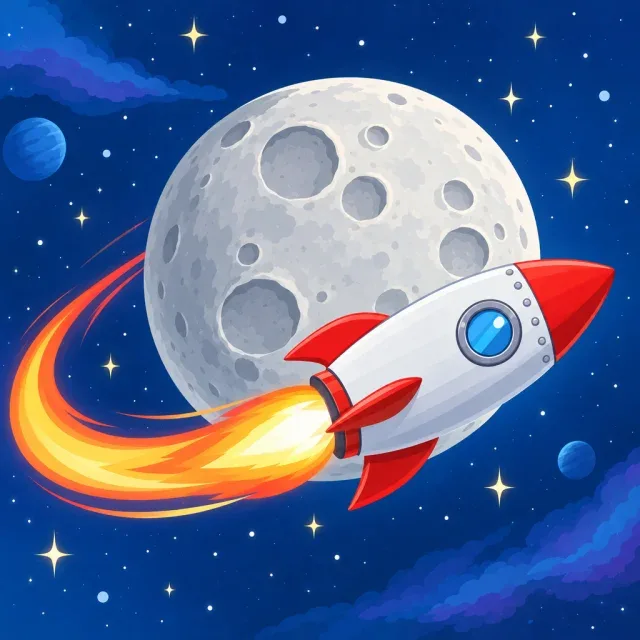
Pick a peaceful cratered Moon, a rocket flying past it, or a storybook scene with a pirate ship, cats on a rooftop, or a wolf howling from a cliff. Other drawings pair the Moon with astronauts, clouds, stars, a castle, or a forest, so you can match the page to the mood and time you have.
A quick guide to the Moon’s phases
The Moon does not make its own light; sunlight illuminates the side facing Earth. As the Moon travels around Earth, we see different portions of that lit side, which creates the familiar phases from crescent to full Moon. The Moon’s changing shape in the sky is not usually caused by Earth’s shadow; that shadow falls across it during a lunar eclipse.
Look closely at the crater drawings, too. The Moon’s round pits and rugged edges give a surface scene a different feel from a smooth crescent in a night sky. For more space-themed coloring, browse Space, or compare the Earth rising above the lunar horizon with Earth.
Choose by age and coloring level
Start with the size of the shapes and how much time your colorist wants to spend. The simpler pictures suit short sessions and young children, while layered scenes and patterned designs reward a steadier hand.
Easy Moon coloring pages for kids
For a 3-year-old, try a large crescent, a sleeping Moon on a cloud, or a smiling Moon with just a few stars. These clear outlines leave plenty of room for broad crayon strokes. A 7-year-old may enjoy adding a story to the astronaut sitting on a crescent, the rocket passing the Moon, or the pirate ship sailing beneath a full Moon.
The teddy bear under hanging stars and the Earth appearing over the lunar horizon give children small details to notice without making the whole picture feel crowded. A fairy resting in the forest, a girl beside a crescent, and a Moon in a scarf offer a little more to color. The chibi astronaut is a cute pick for anyone who likes a playful space scene; Halloween scenes bring bats, a spooky forest, or a big full Moon into the mix.
Detailed Moon coloring pages for adults
For a more involved session, choose the close-up view of craters and trace the rims and shadows carefully. The full Moon behind a castle, with bats crossing the sky, has several areas to shade and gives the scene a dramatic nighttime look.
The crescent dreamcatcher combines beads and flowers with a mandala pattern, while the Moon inside a flower mandala repeats curved shapes around its center. These designs suit colored pencils and patient work, but you can also pick just a few sections to fill and leave the rest light.
What colors suit a Moon scene?
For a familiar lunar look, use pale gray or ivory for the Moon and darker gray for crater rims and shadows. A full Moon can also be warm cream or yellow against a deep blue or purple sky. Add blue and green to the Earth, silver-gray to a rocket, or bright colors to an astronaut’s suit; the smiling and scarf-wearing Moons can be any shade that fits your story.
Keep a simple Moon-phase journal
Turn the crescent and full-Moon pictures into a short observation activity. Look at the Moon from the same place on several evenings, sketch the shape you see each time, and mark the date beside it. Then compare your sketches with the coloring pages, noticing how the lit portion seems to grow or shrink.
You can add a small star map or draw a rocket beside one entry to make the journal personal. If clouds hide the Moon, leave that space blank and try again the next evening.
Print Moon coloring pages as PDFs
Choose Open the PDF to view a drawing, or select Print to print it directly, including from a phone. Use fit-to-page settings if the edges look clipped in the preview. Regular paper works well with crayons and colored pencils; thicker paper is helpful for markers, while pencils make it easier to shade crater details.